

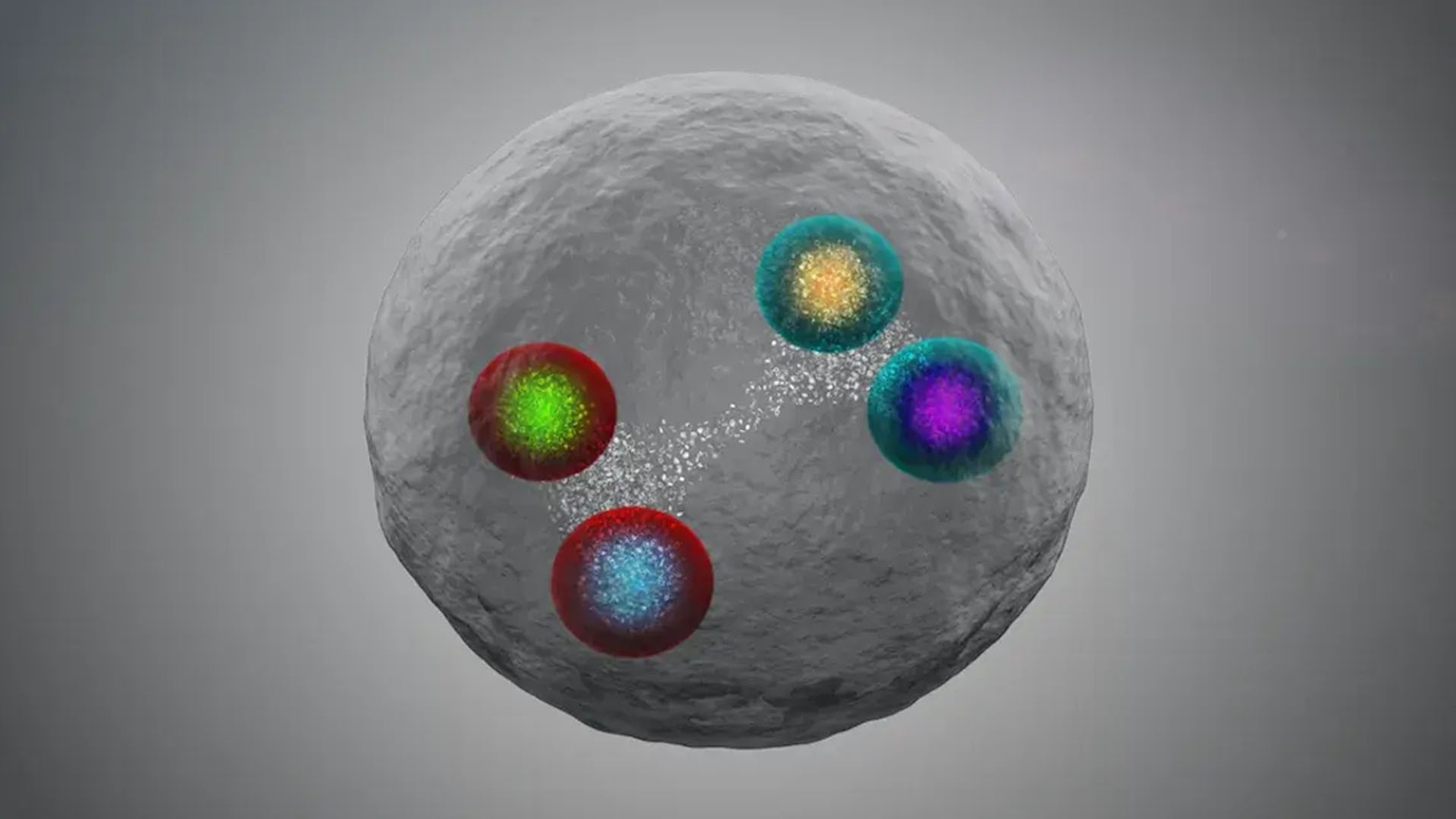
 On Thursday 9 April, Nature published the article ‘High-precision calculation of the quark–gluon coupling from lattice QCD’ [available open access]. The work, the result of a European collaboration, has achieved an unprecedented refinement in the calculation of a fundamental parameter describing the force that holds atomic nuclei together: the strong coupling constant.
This constant, which governs the interactions between quarks and gluons, is essential for understanding the structure of matter at the subatomic scale. The improvement in its determination goes beyond the theoretical realm, as it will allow more precise interpretation of data generated by the various LHC experiments at CERN.
Among the article’s signatories is Alberto Ramos, a researcher at IFIC-CSIC and an experienced user of CESGA’s capabilities. We contact him to learn more about the exact role CESGA played in this significant research.
CESGA’s role: FinisTerrae III as a testing ground
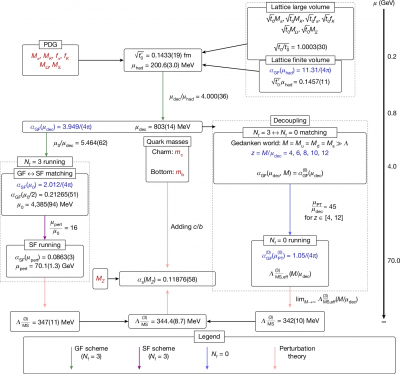
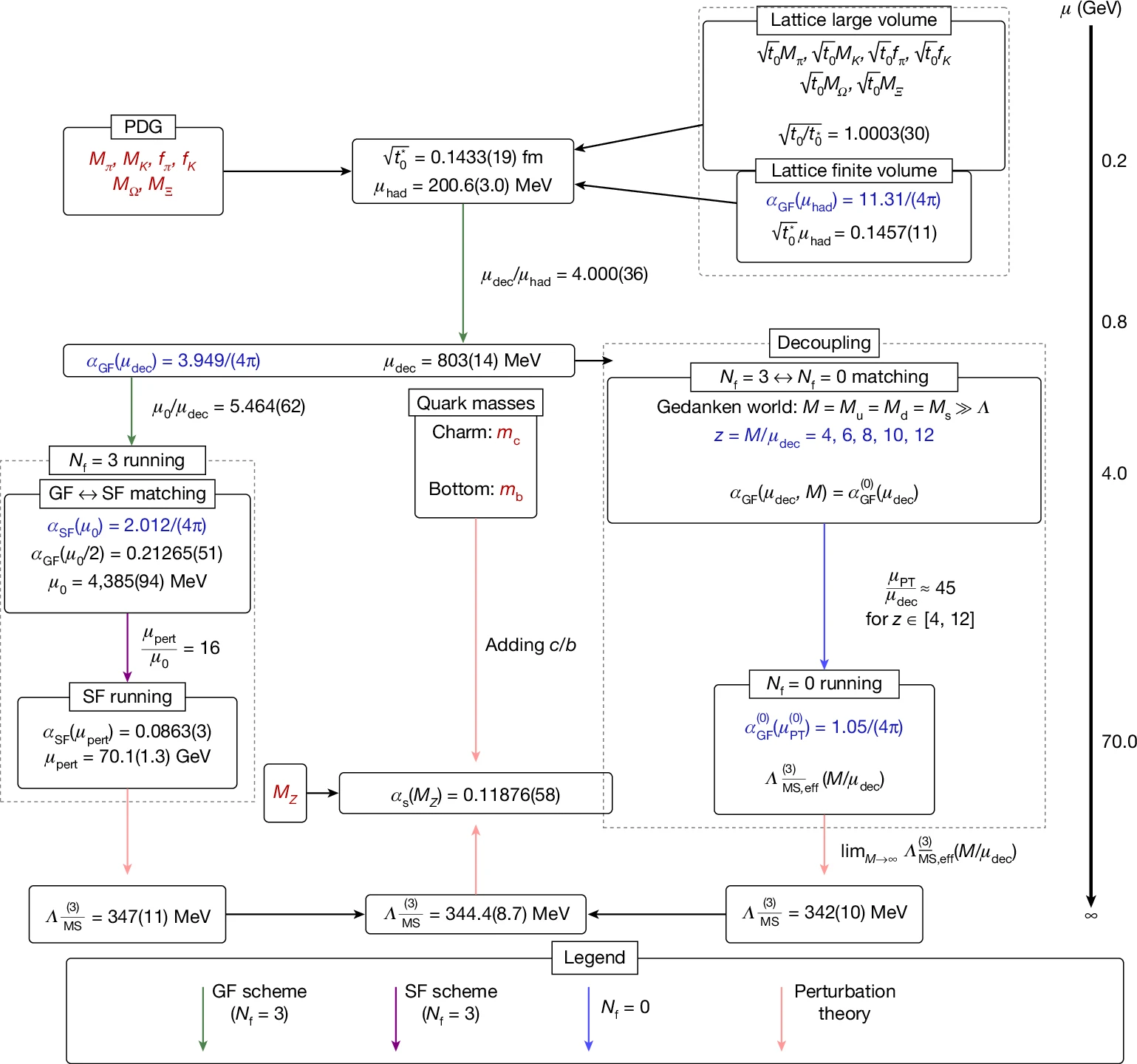
General view of the supercomputation flow applied for this research [source: Nature]. Clic here to fullsize.
“CESGA has played an essential role in the project” -he explains- “as it provides access to CSIC researchers without needing to submit a request with an exact idea, or to wait for the outcome of an evaluation.” “This allows us to test new ideas, understand how efficient our algorithms are, identify which parts need improvement, determine which parameters to simulate, and establish how many simulations are needed to reach a target precision. This information is essential for preparing competitive computing time applications at the European level.”
“FinisTerrae III may not be the largest computer we have used, but having direct and rapid access to CESGA’s resources makes possible the high-level research that depends on HPC resources”.
Supercomputing and new methods
The achievement combines the massive use of HPC with theoretical refinements specific to this study — a powerful alliance that has enabled unprecedented precision: the result for the strong coupling constant is twice as precise as the combination of all experimental data combined. “In recent years we have focused on developing specific methods to solve this type of problem numerically. And now, after massive calculations on supercomputers, we confirm that they far exceed conventional techniques,” Ramos concludes.
How to apply for access and start using CESGA’s infrastructure?
The CSIC-based access that Alberto Ramos used for this research is just one of the routes CESGA offers to allow all kinds of individuals and organisations (research groups, developers, technicians, technology centres, public and private institutions, etc.) to make use of its supercomputing, quantum computing, simulation, and storage infrastructure.
– Via Spanish Sumercomputation Network (RES), through competitive calls.
– Via research groups from Galician universities or CSIC.
– Through institutional agreements.
Browse the sections under the ‘Community’ menu on our website (particularly the documentation in ‘Terms of Use’) for a full overview and to find out which access option best suits your case. If you have any questions, get in touch by phone or email and we will be happy to help.