

 In October 2025, CESGA inaugurated the QKD line between Santiago and Vigo, whose 120-kilometre length made it the longest in Spain. Now, this infrastructure is already on course to break its own record, crossing the border into Portuguese territory thanks to the IberianQCI project. Meanwhile, in April 2026, the VQCC launched the Antonia Ferrín optical ground station for quantum communications.
This project represents a first step towards integrating the existing quantum infrastructures in Spain and Portugal through ultra-secure quantum communication systems and incorporating them into the European quantum communications network (EuroQCI). The first ‘stop’ on Portuguese soil will be located in Valença do Minho, thanks to an extension of approximately 30 kilometres linking the operational line installed at the VQCC with the town.
The IberianQCI project will deploy a terrestrial link and several satellite links to enable communications between the two countries. The terrestrial link will extend the current connection between Santiago and Vigo with a first ‘stop’ in Portuguese territory, specifically in Valença do Minho, through an extension of approximately 30 kilometres. In addition to the satellite link already available at the VQCC, optical ground stations will be established in Lisbon, Madrid and Catalonia to connect to the Eagle-1 satellite, facilitating communication between autonomous communities, countries and the wider European EuroQCI network.
The intention is that, in later phases, the line will reach Lisbon, where a QKD infrastructure already exists covering the metropolitan area of the capital. Likewise, just as we have enabled this connection between Santiago and Vigo on this side of the border, our Portuguese colleagues from PTQCI are developing several connections across their territory with the aim of creating an uninterrupted Lisbon–Valença line, passing through Aveiro and Porto, to connect with Galician territory.
Why an Iberian ultra-secure quantum communications network?
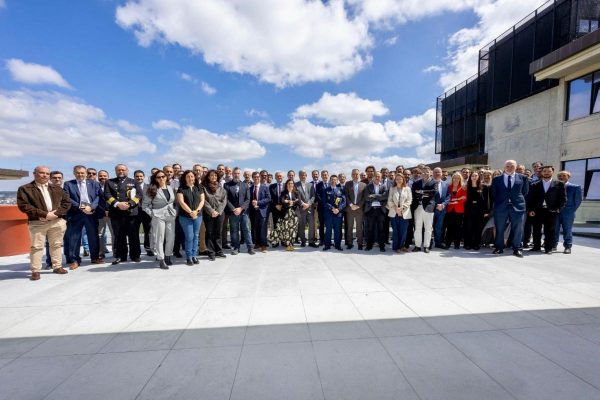
The consortium for IberianQCI project during the kick-off meeting in Lisbon
The European Union is currently engaged in a major process of developing infrastructures and technological tools aimed at providing a sovereign, secure and interoperable communications infrastructure. This will enable both Member States and the Union itself, as a transnational entity, to achieve the highest standards of security in strategic areas such as defence, energy infrastructure, transport, essential supplies and financial operations.
Quantum Key Distribution (QKD), implemented through optical communication systems, represents one of the most successful approaches to addressing these security challenges, particularly in a context where quantum technology itself may compromise current cryptographic methods. However, the same properties that could be used to break existing barriers can also be used to protect them, and this is the principle underpinning QKD lines: they make it possible to detect unequivocally any attempt to intercept cryptographic keys through the continuous monitoring of the quantum properties of the transmitted photons. Any disturbance resulting from unauthorised observation alters the quantum state of the signal and therefore reveals the presence of an intrusion.
A team that ‘hacks’ borders and technical challenges
Delivering the ambitious IberianQCI project requires the involvement of a large number of people, institutions, fields of expertise, technologies, and legal and political frameworks. The IberianQCI consortium, led by Indra, is made up of Portuguese institutions (Infraestruturas de Portugal, IP Telecom, Instituto de Telecomunicações, Altice Labs and Instituto Superior Técnico) and Spanish institutions (Technical University of Madrid, Telefónica, the Spanish National Research Council (CSIC), and the Institute of Photonic Sciences in Barcelona). In Galicia, both CESGA and the VQCC play a key role in the project thanks to the previous hands-on experience both institutions have developed in terrestrial and satellite quantum communications.
Would you like to learn more about QKD technology and CESGA’s experience in this field? Read this article!
